By Nicola Johnson — Founder, pH Clinic | Advanced Colonic Hydrotherapist
There is a conversation happening at the frontier of health science that most people haven’t heard yet. It sits at the intersection of physics, biology, and what I’d call intuitive wellness — the kind of knowledge that, once you have it, makes you look at everything you do differently. It’s about your mitochondria. And the three things they need most that almost nobody is giving them.
Water. Light. Cold.
I want to walk you through this properly — because understanding it changes not just how you think about the therapies we offer at pH Clinic, but how you think about energy, ageing, inflammation, and what it actually means to be well.
What Are Mitochondria and Why Do They Matter?
Mitochondria are organelles — tiny structures inside virtually every cell in your body. Their primary job is to produce ATP (adenosine triphosphate) — the molecule that powers every function your body performs. Every heartbeat, every thought, every immune response, every cellular repair process runs on ATP. When your mitochondria are healthy and abundant, you feel it: sustained energy, clear thinking, resilient immunity, efficient recovery, and the general sense that your body is working with you rather than against you.
When mitochondrial function declines, the consequences are systemic. Fatigue that sleep doesn’t resolve. Brain fog. Slow recovery. Chronic inflammation. Accelerated ageing. Many researchers now believe that mitochondrial dysfunction is not just a symptom of chronic disease — it is a primary driver of it. Dr Douglas Wallace, one of the world’s leading mitochondrial researchers, has proposed that virtually all common chronic diseases — from cardiovascular disease to Alzheimer’s to cancer — share a common thread of mitochondrial dysfunction. The implication is significant: optimise mitochondrial function, and you address the root of an enormous range of health problems simultaneously.
So what do mitochondria actually need? The emerging research points to three things with surprising consistency: structured water, specific wavelengths of light, and controlled cold exposure.
Part One: Water — Not All Water Is Equal

We are told to drink eight glasses a day. We are not told that the quality of those eight glasses may matter as much as the quantity. The water that exists inside your cells — intracellular water — is not the same as the water in a glass. It is structured. Ordered. Organised into what researchers like Dr Gerald Pollack at the University of Washington have termed “exclusion zone water” or EZ water — a fourth phase of water that behaves differently to liquid water, with unique electrical properties. This structured intracellular water plays a direct role in cellular function, including mitochondrial function. Pollack’s research has shown that EZ water carries a negative charge and effectively acts as a battery — storing and releasing energy in ways that support the electrochemical processes mitochondria depend on.
Here’s where it gets practically important.
The water most of us drink — from the tap, from plastic bottles, filtered through standard systems — has been treated, pressurised, and processed in ways that destroy its natural structure. It may be clean in a contamination sense, but it is energetically depleted. It does not readily form EZ water inside your cells. What depletes water quality: chlorination and fluoridation (standard in Australian municipal water), pressurisation through pipes, storage in plastic containers (BPA and microplastics), and PFAS contamination — now found in measurable concentrations in virtually all Australian water supplies, including Northern Beaches catchments.
What creates structured, high-quality water: negative ionisation — water that carries an abundance of electrons — optimal mineral content and alkalinity, and freedom from contaminants and disruptors.
The PFAS issue deserves specific mention. Per- and polyfluoroalkyl substances are synthetic chemicals used in non-stick cookware, food packaging, firefighting foam, and industrial processes. They are called “forever chemicals” because they do not break down in the environment or in the human body. They accumulate in tissue, disrupt endocrine function, and have been linked to immune suppression, thyroid dysfunction, and increased cancer risk. A 2023 investigation found PFAS in significant concentrations in Sydney’s water supply — including Northern Beaches catchments.
Upgrading your water is not a wellness trend. It is a basic act of cellular protection. At pH Clinic, we use and serve electrolysed reduced water — produced through advanced Japanese electrolysis technology — to all clients before their colonic sessions. The negatively charged, restructured nature of this water provides cells with an abundance of electrons — the currency of cellular reduction and repair. The difference in clinical outcomes when clients are hydrated with this water before a colonic is something I have observed consistently for over a decade.
Part Two: Light — Your Mitochondria Are Photoreceptors

This is the piece that surprises people most. Your mitochondria respond to light.
Specifically, they respond to red and near-infrared wavelengths — the same wavelengths produced by our red light therapy panels at pH Clinic. The mechanism was elucidated largely through the work of researcher Tiina Karu, whose decades of research demonstrated that cytochrome c oxidase — a key enzyme in the mitochondrial electron transport chain — acts as a photoreceptor, absorbing red and near-infrared light and using that energy to accelerate ATP production. n plain language: when your mitochondria are exposed to red and near-infrared light, they produce more energy. More efficiently. With less oxidative stress as a byproduct.
The documented effects of red and near-infrared light on mitochondrial function include increased ATP production — multiple studies have demonstrated measurable increases in cellular ATP following red light exposure, the direct result of cytochrome c oxidase activation. More ATP means more cellular energy available for every function your body needs to perform. Red light therapy also reduces reactive oxygen species (ROS). Mitochondrial ATP production naturally generates reactive oxygen species as a byproduct — essentially cellular exhaust. When this exhaust accumulates faster than your antioxidant systems can neutralise it, oxidative stress results. Red light therapy has been shown to reduce ROS production during cellular energy generation — cleaner energy production with less cellular damage.
Perhaps most significantly, red light stimulates mitochondrial biogenesis. Red light exposure has been shown to activate PGC-1α — the master regulator of mitochondrial biogenesis, the process by which cells create new mitochondria. More mitochondria means greater energy production capacity. This is not a temporary boost — it is a structural improvement in cellular energy infrastructure. The connection to water is worth noting here. Pollack’s research has shown that EZ water formation inside cells is stimulated by infrared light exposure. This creates a direct synergy between red light therapy and structured water intake — the light helps your cells build and maintain the biological battery that structured water creates.
Part Three: Cold — Building New Mitochondria Through Stress
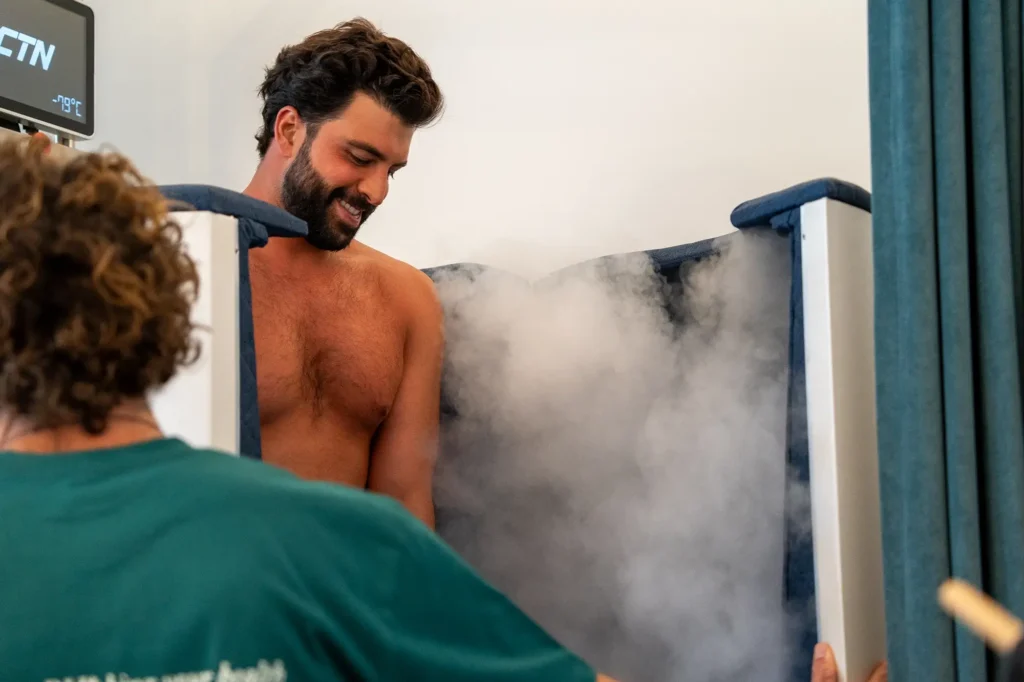
If light charges your mitochondria and structured water powers them, cold exposure builds more of them.
Cryotherapy — and cold exposure more broadly — activates a cellular stress response that is fundamentally different to chronic stress. Brief, controlled cold exposure is a hormetic stressor: a mild challenge that triggers adaptive responses that leave your body stronger and more resilient than before.
The mitochondrial pathway of cold exposure works primarily through two mechanisms. First, cold shock proteins and mitochondrial repair: just as infrared heat activates heat shock proteins, cold exposure activates cold shock proteins — a family of proteins including RNA-binding motif protein 3 (RBM3) that have been shown to play a direct role in synaptic repair and mitochondrial quality control. Cold shock proteins essentially act as cellular editors — identifying damaged mitochondrial components and either repairing or clearing them.
Second, mitochondrial biogenesis via PGC-1α: cold exposure — like red light — activates PGC-1α, the master regulator of mitochondrial biogenesis. A landmark study demonstrated that cold acclimation in humans produced a measurable increase in mitochondrial density in skeletal muscle — more mitochondria per cell, meaning greater energy production capacity.
Research from the Garvan Institute found that cold-activated brown adipose tissue (BAT) — fat tissue that burns energy to generate heat — is densely packed with mitochondria and becomes more metabolically active with repeated cold exposure. This has implications not just for energy metabolism but for insulin sensitivity, inflammation, and longevity. Whole-body cold exposure also triggers a significant norepinephrine release — research has documented 200–300% increases in circulating norepinephrine following cryotherapy. Norepinephrine is both a neurotransmitter and a hormone, and its effects are wide-ranging: reduced inflammation, improved mood and focus, and activation of mitochondrial biogenesis pathways.
The Stack: Why Water, Light, and Cold Work Best Together
Understanding each element in isolation is useful. Understanding how they interact is where the real power lies. Structured water and red light work together because EZ water formation inside cells is stimulated by infrared light exposure. Cells that are well-hydrated with structured water show greater response to red light therapy. The two reinforce each other at a cellular level.
Red light and cold both activate PGC-1α and mitochondrial biogenesis through different pathways. Used together — or in sequence — they create a compounding stimulus for the creation of new, healthy mitochondria. This is one reason our clients who combine cryo class with red light therapy consistently report energy changes that surprise them.
Cold exposure increases the efficiency of cellular water organisation. Following cryotherapy, drinking structured water supports the cellular environment that cold has primed — replenishing electron density at precisely the moment cells are most receptive. And when all three are combined with colonic hydrotherapy, the effect compounds further. A congested, inflamed gut is one of the primary sources of systemic oxidative stress — the enemy of mitochondrial function. When the gut is clear and the microbiome is supported, absorption of minerals and nutrients improves. Your cells can actually use the structured water and light you’re giving them. The colonic is the foundation that allows everything else to work more effectively.
This is not an accident of what we offer at pH Clinic. It is the logic behind it.
Practical Takeaways
You do not need to overhaul everything at once. Start where it’s easiest and build.
- For water: begin by reducing plastic bottle consumption and looking into your home water quality. Consider filtering at minimum. If you’re interested in our premium Japanese electrolysis water technology — which we use at the clinic and recommend for home use — come in and try it, or enquire about our payment plan options starting from $59 per week.
- For light: book a red light session and notice how you feel. For skin, inflammation, energy, and mood — particularly in winter — 20 minutes twice a week is a meaningful starting point. Build to three to four times weekly for deeper mitochondrial benefit.
- For cold: if you’re new to cold therapy, start with our XCryo localised treatment or a cryo facial before working up to full body cryotherapy or a Cryo class. The nervous system adaptation to cold is real — it becomes easier and more pleasurable with repetition.
- For all three together: book a cryo class followed immediately by red light therapy, and drink a large glass of our electrolysed water beforehand. It is one of the most energising experiences we offer — and the most complete single-visit mitochondrial intervention available.
Passes and Memberships now available. Book here or call us on 0420 644 852.
References
Pollack GH. (2013). The Fourth Phase of Water: Beyond Solid, Liquid, and Vapor. Ebner & Sons.
Karu TI. (2010). Mitochondrial Signaling in Mammalian Cells Activated by Red and Near-IR Radiation. Photochemistry and Photobiology.
Hamblin MR. (2016). Shining Light on the Head: Photobiomodulation for Brain Disorders. BBA Clinical.
Cypess AM, et al. (2009). Identification and Importance of Brown Adipose Tissue in Adult Humans. New England Journal of Medicine.
Shevchuk NA. (2008). Adapted Cold Shower as a Potential Treatment for Depression. Medical Hypotheses.
Laukkanen T, et al. (2018). Sauna Bathing and Systemic Inflammation. European Journal of Epidemiology.
Genuis SJ, et al. (2012). Blood, Urine, and Sweat Study. Archives of Environmental Contamination and Toxicology.